
Butler County Deed Types
The Butler County Register of Deeds records the instruments that affect land in the county. A deed marks a transfer between parties. A mortgage, release, easement, or lien works differently. Read the document type first. That habit keeps a searcher from mistaking every index hit for a sale. Butler County deed records also hold other instruments. These clarify or burden title without changing the owner.
| Deed Type | What It Does | Common Use |
|---|---|---|
| Warranty deed | Conveys the stated interest with broad title promises. | An ordinary arm's-length transfer. |
| Quitclaim deed | Conveys only the interest the grantor may hold. | Family transfers or curing a title issue. |
| Trustee or fiduciary deed | Transfers land through an authorized trust or estate representative. | Trust and estate administration. |
| Tax or sheriff's deed | Records a transfer after the required court or tax-sale process. | Confirmed foreclosure proceedings. |
| Correction deed | Corrects a stated defect in an earlier recorded instrument. | Names, descriptions, or drafting errors. |
A mortgage secures a debt. A release shows that a recorded claim was discharged. An easement can grant use rights across land. Reconstructing the paper trail means reading each instrument beside its legal description, because a shared owner name alone never proves that two results concern the same tract.
Landmark Web Search Modes
Landmark Web sits behind a disclaimer page. Six search paths lead into the recorded index. The exact fields within each mode are not documented. Preserve the labels you actually see on screen, and avoid guessing about required fields or image access.
| Portal choice | Best starting clue | Likely research use |
|---|---|---|
| Name Search | Grantor or grantee | Follow transfers tied to a known party. |
| Document Search | Known instrument reference | Return to a specific filing. |
| Book and Page | Book/page from GIS or another deed | Open the cited record. |
| Consideration | Recorded amount, if indexed | Narrow a transfer clue without treating it as value. |
| Record Date Range | Approximate recording period | Limit a broad name search. |
| Legal Search | Lot, block, section, or tract wording | Match the land rather than just the party. |
The portal identifies itself as Landmark Web version 1.5.96.0. Its disclaimer says the data is not warranted accurate and includes the Kansas list-use warning. Any critical result should be checked against the recorded instrument or confirmed with the recorder.
The disclaimer gate doubles as the search-mode entry point. Open Landmark Web to see the current interface.
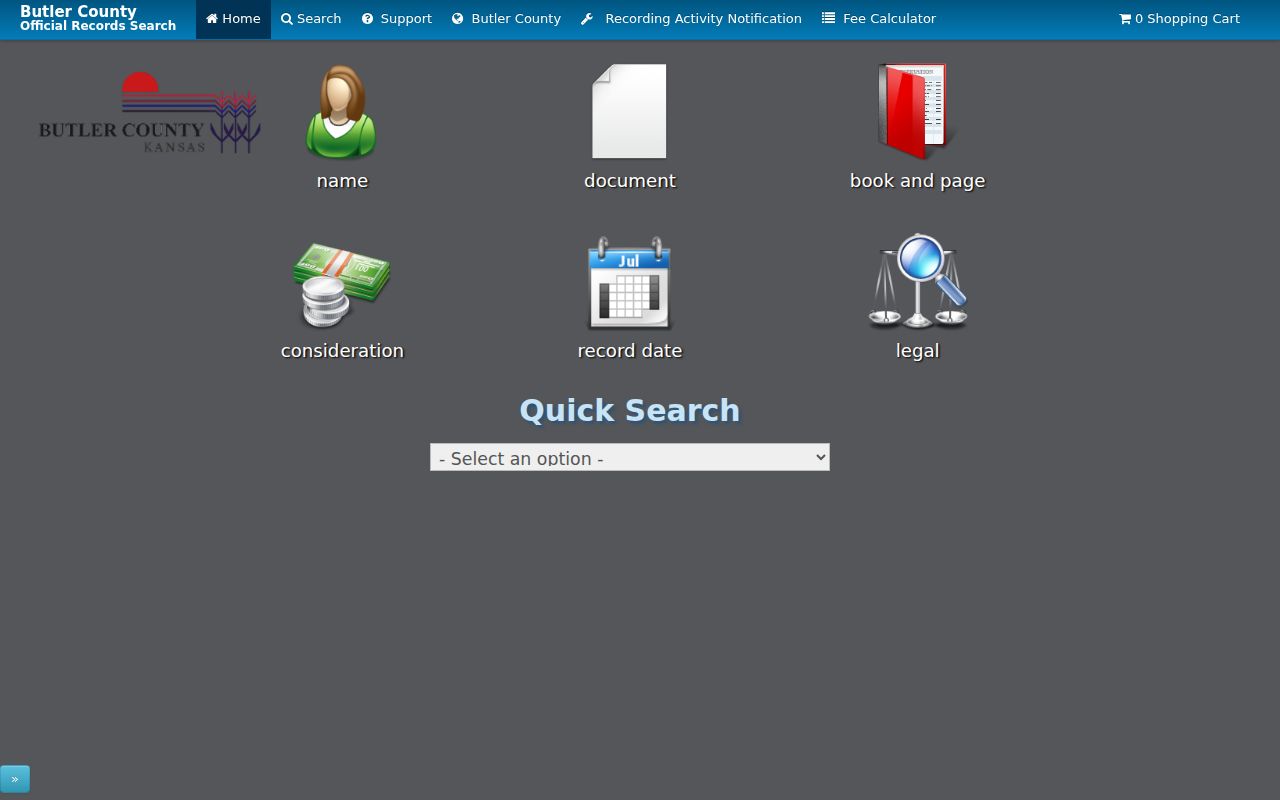
The image shows the recorder portal. The instrument itself remains the controlling source for parties, recording date, legal description, and deed reference.
Butler Deed Coverage Dates
The county Quick Links page describes real-estate recordings from 1952 to date. That is the best published statement available. It does not promise that every search mode or document image starts in 1952. Cutoffs, image availability, sorting, and payment controls can vary by mode. Treat the date as a service description rather than a guarantee.
The distinction matters. An index entry can exist without its image online. A book and page may point to a volume only staff can pull. Save the search date and the portal's exact response. Do this whenever a missing hit could affect a chain of title.
Search adjacent record dates when an expected instrument does not appear. Recording may lag the signing or closing. Spellings and entity punctuation can vary in an index. A legal search or book/page reference can bypass a weak name match. If nothing works, ask at the in-person counter. Staff can check whether the document sits under a different party or instrument type.
Note: Treat 1952 as the county's service description. It is not a guarantee that every instrument image begins that year.
Follow Butler County's Deed Chain
A grantor-grantee index runs on names. Start with the newest reliable deed reference. Find the seller named as grantor. Then locate the deed through which that seller acquired the same legal description, repeating one transfer at a time. Dates, book/page references, document type, and land description make the chain auditable.
- Use the parcel's recent book/page reference or search the current grantee in Landmark Web.
- Open the newest conveyance and copy its grantor, grantee, date, document type, and full legal description.
- Search the grantor as an earlier grantee, then confirm that the earlier deed describes the same land.
- Continue until the online trail ends, then move to the deed books and historical indexes.
- Grantor
- The party that transferred the stated interest.
- Grantee
- The party that received the stated interest.
- Chain of title
- The linked sequence of recorded transfers affecting the same land.
- Book/page or instrument number
- The recorder's locator for a filed document.
A chain of warranty deeds rarely runs clean. A quitclaim, tax deed, affidavit, probate filing, or correction can interrupt the neat series. Keep it in the chronology. State plainly what the instrument actually did. No name match beats the land description when confirming a parcel.
Build a working table with one row per transfer. List the recording date, grantor, grantee, document type, book/page or instrument number, description, and any exception. The table exposes a gap, a duplicate name, or a partial conveyance before it hardens into a false conclusion.
Legal Descriptions Control Butler Deeds
The county's recording guidance requires a complete legal description. A tax-roll tract reference alone is not enough. Platted property may need an addition name with lot and block. Rural land may use section, township, range, and metes-and-bounds language, and later plats, corrections, or lot splits can change the wording that identifies the land.
Compare the description on each deed with the current parcel and any recorded plat. Street addresses can change. They may also cover only part of a tract. This check keeps a same-name result from pulling the chain onto the wrong property.
Recording Rules in Butler County
Every instrument headed into Butler County deed records must clear the recorder's filing rules first. Bring an original, not a copy. Notarized signatures are mandatory, and the seal and commission expiration must read clearly. A deed carries a Sales Validation Questionnaire or an exemption number. An Affidavit of Equitable Interest also requires the questionnaire. When applicable, a mortgage-registration exemption affidavit must travel with the mortgage itself.
The first page must reserve a blank space of 1½ by 3¼ inches for the recording stamp. Filing fees come due at recording. Illegible or incomplete papers face rejection. These rules cover acceptance, not the interest conveyed.
Note: Acceptance by the recorder settles nothing about ownership; it only means the filing met the recording requirements.
Historic Butler County Deed Books
Older land transfers in Butler County live in two places. The Kansas Historical Society Butler collection holds deed records from 1860 through 1926, and its companion General Index to Deeds reaches from 1868 to 1920. The index is the practical starting point. Grantor, grantee, instrument type, volume, page, and land description all appear in its columns, so a parcel can be traced hand to hand across decades of Butler County deed records.
The archive and the modern recorder portal are separate systems. Treat them that way. A book and page citation from one is the bridge into the other, nothing more. For landowner context before the earliest deeds, the 1885 Butler County atlas helps. It shows owners and town plats in placenames fixed to a single year. An atlas entry is a snapshot, though, and never proof of title on its own.
Deeds Recorded Near Tax Cutoff
The Register of Deeds set an October 15 cutoff for deeds and plats meant to appear in the 2026 tax notices. An instrument filed later can still be validly recorded. The next tax statement may simply show the former notice name. How many days pass between recording, Clerk transfer work, a GIS refresh, and the Appraiser update is not published.
Match the recording date against the tax-notice year before calling a mismatch an error. The newest deed leads the title chain. The Treasurer's name only serves tax administration. If the gap stays unexplained, call the recorder at 316-322-4113 or ask the Clerk to review the transfer record.
Obtain a Butler County Deed
Start from the image or reference available through Landmark Web. When the document is not viewable, contact the Register of Deeds on the first floor of the Historic Courthouse at 205 W Central Avenue in El Dorado, Kansas 67042. The office is open Monday through Friday, 8 a.m. to 5 p.m. Call 316-322-4113 or 800-822-6803. Give the exact book and page or instrument reference. Say whether you need an ordinary or an official copy. The office publishes no copy-fee schedule. Ask for a current quote.
Mail and in-person help are the sound fallback when the portal lacks an image. A narrow Butler County open-records request can name the department and the precise record sought. For an older deed, give the Kansas Historical Society the party names, date range, volume and page clue, and land description.
Recorded is not guaranteed. Butler County's index shows what entered the public record. It is not a title opinion, and unrecorded interests or defects may still exist.