
Trace Butler County Former Owners
Pull the most recent book and page from the county parcel pop-up, or open the present grantee in Landmark Web and work from there. Read the deed itself. Note the prior grantor, the legal description, the date, the vesting language, and any earlier reference the document cites. That single record becomes the first row of your backward timeline.
| Source | Years It Covers | Where Held | What It Shows |
|---|---|---|---|
| Landmark Web | County describes 1952 to date | Register of Deeds | Modern party and instrument leads |
| Deed records | 1860-1926 | Kansas Historical Society | Earlier recorded transfers |
| General deed index | 1868-1920 | KHS microfilm | Parties, nature, volume, page, land |
| Butler atlas | 1885 snapshot | Kansas Memory | Landowners, towns and plats |
The county describes its coverage as 1952 to date. But that phrase is a service description, not proof that every image and search mode reaches back that far. Carry a verified book/page or land description into the historical collection before trusting it. When a name search comes up empty, try Book and Page Search, Document Search, Legal Search, or a narrow Record Date Range Search. Keep the same tract in view at every step. Similar surnames can belong to entirely different former owners elsewhere in Butler County.
Walk Butler's Deed Chain Backward
A grantee receives an interest, and a grantor conveys one away. A chain of title is simply the ordered set of instruments affecting the same land, so work one recorded link at a time.
- Find the latest deed with the current party as grantee.
- Read its grantor and exact legal description.
- Search that grantor as an earlier grantee.
- Confirm the same land and record the cited book/page.
- Repeat in deed books and microfilm when the portal stops.
- Grantor / grantee
- The conveying party and receiving party.
- Chain of title
- The linked sequence of land instruments.
- Legal description
- The land language that survives an address change.
Audit Butler County Prior Owners
Build a working table as you go. Track the transfer date, grantor to grantee, deed type, book/page or instrument number, legal-description match, consideration, and any exceptions. Warranty, quitclaim, tax, trustee, correction, and sheriff's deeds can each mark a very different kind of event. Each deed type can mark a very different kind of transaction. A mortgage or a release changes a debt record, not the owner of record. Keep it off the chain.
| Transfer date | Grantor to grantee | Instrument | Land check |
|---|---|---|---|
| Latest confirmed date | Prior owner to current grantee | Keep exact deed type | Match full legal description |
| Next earlier date | Earlier owner to prior grantee | Note sale or non-sale event | Follow the cited prior reference |
Let a missing link stay visible. Record the last confirmed instrument plus the exact open interval instead of inserting an owner from a directory or tax roll.
Decode Butler's Older Land Descriptions
Older Butler County deeds often use section, township and range. Others describe the land by a subdivision lot and block rather than a modern street. A parcel can also be split, combined, or folded into a later addition. Compare the legal description at every transfer. The county subdivision plat index helps connect an older lot to later showings and additions.
One caution comes from the county itself. An original plat copy will not show every later correction. Relying on a current address alone can pull the former-owner chain onto the wrong tract. Plats, later deeds, and the parcel outline all have to agree.
Note: Do not infer a Butler parcel number from a map-book page or an old legal description because the county has published no PID syntax.
Read Butler County Transfer Types
Deed types deserve close reading. A quitclaim can change recorded interests without any conventional sale. A correction deed may repair a flawed description while leaving beneficial ownership untouched. Trustee and estate deeds carry the chain through administration. A sheriff's deed can follow court confirmation. Preserve each instrument's exact name in the chain.
Consideration needs care too. A nominal or exempt amount proves nothing about market value. Easements, restrictions, covenants, rights of way, affidavits of survivorship, and probate conveyances can explain a great deal. They show why two owner records seem to disagree. Search those related instruments only when they touch the same legal description.
Tax foreclosure adds its own sequence. Butler County says a sheriff's deed follows court confirmation. It is mailed roughly 30 to 45 days later. Some liens may be extinguished, while covenants, restrictions, and easements can survive. Keep the court case, sale notice, confirmation order, and recorded sheriff's deed as separate sources. Do not compress them into one seller-to-buyer row.
Access Butler County Deed History
The Butler County Register of Deeds sits on the first floor of the Historic Courthouse at 205 W Central Avenue in El Dorado. Stated hours are Monday through Friday, 8 a.m. to 5 p.m. The office lists 316-322-4113 and 800-822-6803. Call ahead before visiting for older books, and ask about inspection and copy options.
The online portal does not publish its exact image coverage, every search field, download behavior, or mode-specific fees. For a focused missing record, file the county open-records form or contact the recorder directly. The official Landmark Web opening screen is the entry point for deed searches, not a sample parcel result. View the official Landmark Web opening screen.
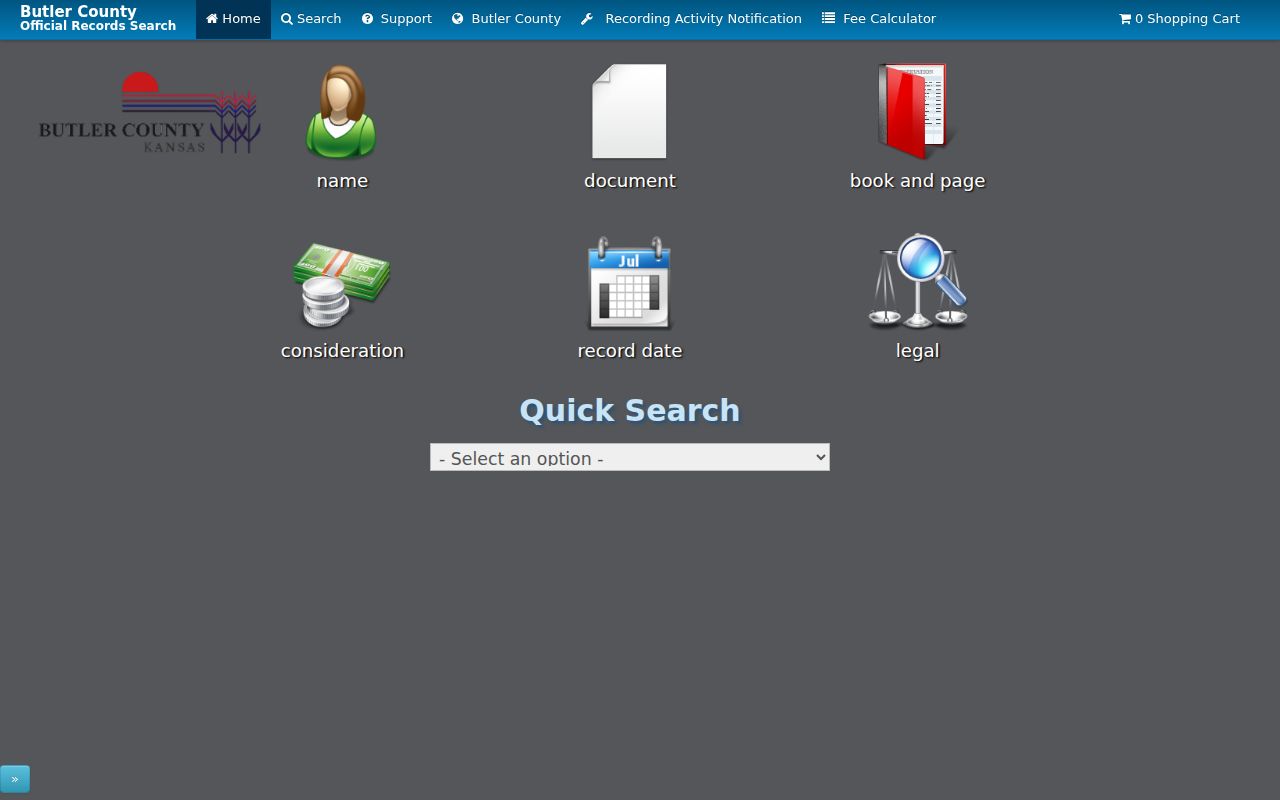
The portal's disclaimer gate and search-mode entry point both matter. A careful former-owner search preserves the portal's terms and verifies each deed result against the recorded instrument.
Corroborate Butler County Past Owners
Directories, old tax rolls, maps, and court files can explain a name or a date. They cannot serve as deed-chain links. A directory may place a person at an address in a given year. A court docket may show a dispute. Neither records a conveyance.
Use those sources to settle spelling, estate, foreclosure, or location questions. Then return to the recorded deed. Label each source by its real role. That discipline keeps previous owners distinct from taxpayers, residents, lenders, and people named only in litigation.
Reach Butler County's Earlier Owners
Tracing an older owner in Butler County often starts with archived deed material. The Kansas Historical Society Butler collection holds deed records from 1860 through 1926. It also holds quitclaim deed records from 1901 through 1924 and tax deeds covering 1892 through 1926. A general deed index extends from 1868 through 1920 across microfilm volumes MF3367 through MF3376. Each entry records the date, grantor, grantee, instrument type, volume, page, remarks, and a general land description. That level of detail lets you follow a parcel's ownership backward deed by deed. The 1885 Butler atlas helps too, mapping township landowners and town plats. Treat an atlas name as a dated clue rather than proof. Stop at the last supported instrument. Mark any gap plainly.
Lawful use. Former-owner research supports house history, estate work, and land diligence. Never use historic or current names to track, expose, or harass anyone.